

6 min read
For as long as humans have looked skywards, the sun has commanded awe, reverence and gratitude.
Ancient Egyptians worshipped Ra as the giver of life. The Incas and Aztecs built entire cosmologies around the sun’s power. Stone age Britons aligned Stonehenge with the solstices, while in Hinduism Surya remains a living deity. Long before electrons and grids, humanity understood an essential truth: the sun underpins everything.
In a far more technical age, we are rediscovering that wisdom. Solar power has moved from the margins to the mainstream at a pace that has surprised even those of us who have spent years working in and around the energy transition. What once felt like a worthy but niche technology is now one of the dominant forces reshaping the global energy system.
From where I sit, the most important point is this: the energy transition is no longer a theoretical exercise. It is happening in real time, at scale, and it is being shaped by those countries and organisations willing to think systemically rather than incrementally.
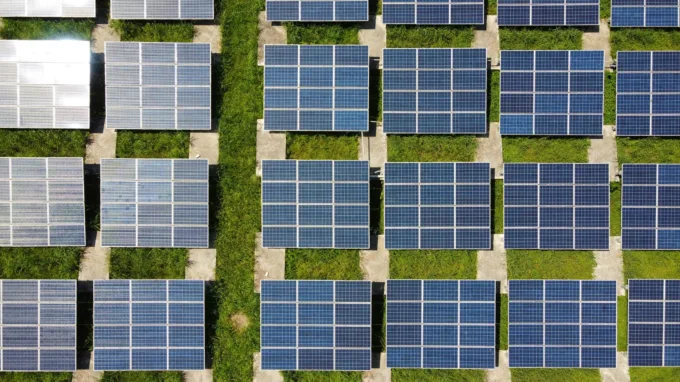
Photo credit: Anders J
From slow burn to solar surge
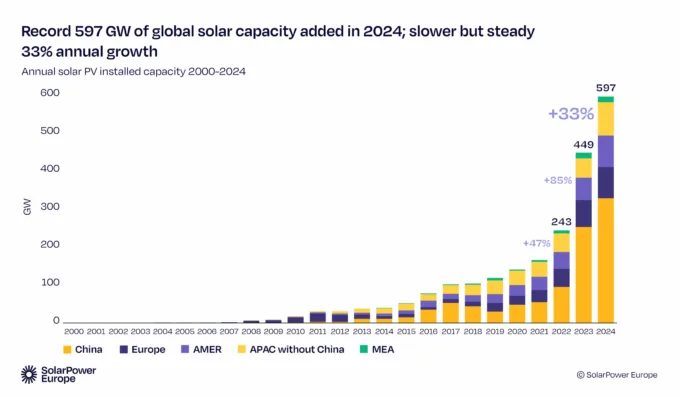
The numbers tell a remarkable story. It took almost seven decades – from the invention of the modern solar cell in 1954 until 2022 – for the world to install the first 1,000 gigawatts (GW) of solar capacity. Then something extraordinary happened. In just two more years, global capacity doubled to 2,000 GW. Few technologies in human history have experienced such a dramatic acceleration.
This surge is not accidental. Solar panel costs have fallen by around 90% globally over the last decade, and by roughly 99% since the 1970s. What was once prohibitively expensive is now among the cheapest forms of electricity ever produced. Solar is also uniquely modular and fast to deploy: it can be installed on a home roof in days, rolled out across warehouses and car parks, floated on reservoirs, or scaled up into vast solar parks in a matter of months rather than years.
Just 1.5 hours of sunlight hitting the Earth contains enough energy to power the entire world for a year. We are finally learning how to tap into that abundance at scale.
Why solar is growing so fast
Several forces have converged to drive solar’s rapid rise.
First, economics. In much of the world, new solar is now cheaper than new fossil fuel generation, even before accounting for carbon costs. Once panels are installed, the fuel is free. There is no exposure to volatile global commodity markets or geopolitical shocks.
Second, energy security. Recent years have laid bare how fragile energy systems can be when they rely heavily on imported fuels. Resilience increasingly comes from diversity and domestic capability, not from doubling down on any single technology or supply route. Solar’s ability to be deployed almost anywhere gives it a unique strategic value.
Third, climate urgency. Solar has avoided an estimated 1.4 gigatonnes of CO₂ emissions each year over the past six years – equivalent to the combined annual emissions of France, Germany, Italy and the UK. For countries with legally binding net zero targets, scalable low-carbon power is no longer optional.
And finally, policy and innovation. Supportive frameworks, advances in grid management and the rapid growth of battery storage have helped solar move from a complementary technology to a central pillar of modern power systems.
China and the lessons for energy leaders
No discussion of solar’s rise is complete without China. In just six months, China added more than 250 GW of new solar capacity – more than the entire installed solar fleet of the United States. By the end of 2024, global solar capacity had risen from around 1.6 terawatts to well over 2 terawatts, driven largely by Chinese manufacturing scale and deployment.
China has invested an estimated $50 billion in solar PV since 2011 and now accounts for more than three-quarters of global manufacturing capacity. Companies such as Longi, Trina Solar and JinkoSolar have relentlessly driven down costs, reshaping global supply chains in the process.
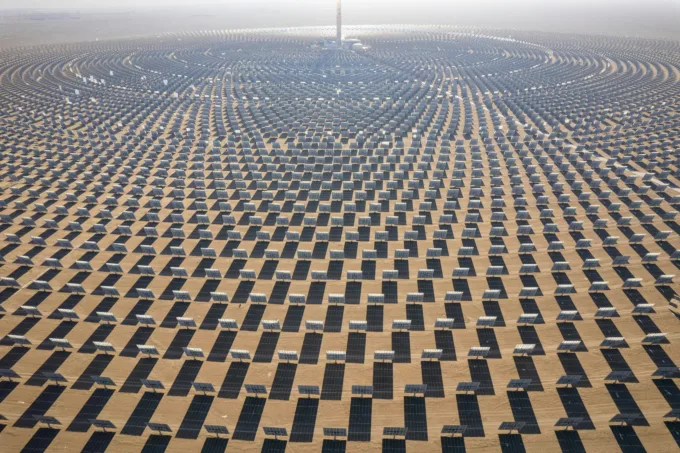
The lesson for the UK is not to copy China wholesale, but to learn from its clarity of intent. China treated solar not as a marginal green add-on, but as core national infrastructure. It aligned industrial policy, planning, finance and grid development behind a single direction of travel. That systems thinking is arguably the most transferable insight for UK energy companies and policymakers.
China’s growing integration of solar with battery storage is equally instructive. High solar penetration forced innovation in flexibility, pricing and storage – challenges the UK will increasingly face. Learning early, rather than reacting late, will be critical.
The UK opportunity: solving the energy trilemma
For the UK, solar power has a particularly important role to play in addressing the long-standing energy trilemma: security, decarbonisation and affordability.
On affordability, solar is already delivering. An all-day occupied household can save hundreds of pounds a year through rooftop solar, while large-scale projects help suppress wholesale prices by displacing gas generation. In 2025, the UK generated around 14.4 billion kWh of solar electricity – enough to power more than five million homes.
On security, solar strengthens domestic supply. As North Sea production declines and gas imports rise, homegrown renewables reduce exposure to volatile global markets. Solar’s diversity of deployment – from rooftops to grid-scale – also adds resilience to the system.
On decarbonisation, the impact is clear. Renewables now provide around 37% of the UK’s electricity, overtaking fossil fuels for the first time. Solar is the fastest-growing contributor within that mix.
Crucially, solar does not stand alone. It complements wind, nuclear, hydro and – for now – gas. Gas will continue to play a balancing role in the near term, but every additional solar panel reduces fuel burn, emissions and costs. The future energy system is not about replacing one technology with another, but about building a smarter, cleaner mix.

Photo credit: IKEA
Solar and a just transition
Beyond electrons and economics, solar also has a powerful social dimension. The UK solar sector already supports tens of thousands of jobs, with the potential to double employment by 2030. These roles span installation, maintenance, engineering, planning, finance and community engagement – many of them rooted in local economies.
Solar’s flexibility opens the door to more democratic energy systems. Community solar, public-sector installations and rooftop systems allow people to participate directly in the transition. A just transition is not only about moving fast, but about taking people with us. Solar’s accessibility makes it one of the most powerful tools we have to do both.
What needs to happen next
If solar is to deliver its full potential for the UK energy system, we need to move beyond celebration and focus on execution. In my view, several priorities stand out.
- Think system-first, not technology-first. Solar must be planned alongside storage, flexibility, demand response and grid upgrades. The value comes from the system it enables, not from capacity alone.
- Speed up planning and grid connections. Delays, uncertainty and inconsistency remain major barriers. Clearer national direction and regional coordination can unlock investment without compromising community trust.
- Integrate storage as standard. High solar penetration demands flexibility. Batteries, smart tariffs and digital controls should be treated as core infrastructure, not optional extras.
- Use public assets boldly. Schools, hospitals, public land and buildings offer immediate opportunities to scale solar, cut public-sector costs and demonstrate leadership.
- Anchor solar in industrial strategy. Skills, supply chains and local economic benefits should be designed in from the start, supporting a genuinely just transition.
Looking ahead
The pace of change in solar is unlikely to slow. Global capacity continues to rise exponentially, costs keep falling, and storage is rapidly catching up with generation. In some markets, solar power is already so abundant that midday electricity prices turn negative – a clear signal that the next frontier is flexibility rather than generation alone.
For the UK, the opportunity is clear. By learning from global leaders, thinking systemically and treating solar as core infrastructure, we can make faster progress on affordability, security and decarbonisation at the same time.
The sun has always powered life on Earth. Now, at last, it is beginning to power our economies too – and if we get this right, it can power a fairer, more resilient energy system for decades to come.