



9 min read
Strategy is not usually killed by one big mistake.
It's enemy is drift.
A decision waits for another meeting. A priority becomes one of 14 priorities. The executive team agrees the words but not quite the meaning. The CEO thinks the organisation is moving in one direction. The organisation, with great sincerity and several steering groups, is moving in four different directions.
This is the hard part of leadership now.
Most organisations are not short of ambition. The energy sector certainly is not. The challenge is execution: turning strategic intent into decisions, decisions into action, and action into confidence.
That is why the role of chief of staff is so important.
McKinsey has analysed around 250 chiefs of staff who served in the role over an eight-year period, across roughly 300 organisations. It also found that around three-quarters of those chiefs of staff supported CEOs, with the rest serving other senior leaders.
That's worth considering.
This is no longer just a political job, a military job or a Silicon Valley curiosity. It is becoming part of the operating model of modern leadership.
A traditional role for a current problem
The chief of staff role has military roots. Commanders needed people around them who could organise information, coordinate action and turn their decisions into movement.
Politics then made the role famous. Presidents and prime ministers needed someone to manage access, staff, policy flow, decisions and the daily collision between events and priorities.
Businesses have borrowed the model because they face the very same challenges.
The job around the CEO has become more crowded, faster and more exposed. There are more ways for a good strategy to get lost between the boardroom and the business.
The role has grown because the centre needs to hold.
What the role is and what it is not
The chief of staff is often confused with other roles such as chief operating officer, strategy director and executive assistant.
However, done properly the role is clearly distinctive. The chief of staff exists to help the CEO's strategic vision happen.
At its best, the role is part strategist, part translator, part air-traffic controller and part consigliere. The chief of staff is close enough to the CEO to understand their intent, trusted enough by colleagues to tell the truth, and practical enough to know when a 'strategic discussion' is really just a euphemism for decisions being avoided.
There is also a mild enforcer role.
Not in a dramatic way involving darkened rooms and horses' heads. But someone does need to say: we agreed this six weeks ago; why has nothing moved?
Every leadership team needs a person who can ask that question and still be invited back.
The role without the title
Many organisations already have a chief of staff in practice. They just may not call it that.
The role may sit with a corporate affairs director, a strategy lead or a transformation director.
There is a compelling case that Corporate Affairs Directors and Chief Communications Officers (CCOs) are particularly well-suited to formalising this role. Their existing proximity to the CEO, their cross-functional view of the organisation, and their instinct for narrative, alignment and stakeholder management give them a natural head-start.
The evidence is growing. Korn Ferry's 2025 survey of Fortune 500 CCOs found that nearly half now report directly to the CEO - a rise of 17 percentage points in just two years - and more than half now sit on their company's Executive Committee.
Research presented at Davos in early 2025 found that the ability to build internal consensus across functions and disciplines has become one of the defining capabilities for communications leaders. That is, in effect, a description of the chief of staff role.
In the absence of a formally appointed chief of staff, it is often the Corporate Affairs Director or CCO who absorbs the function by default. They already translate the CEO's intent for internal and external audiences. They already sit at the intersection of strategy, reputation and stakeholder confidence. They are often the first call when a sensitive decision needs sounding out.
That can work until it does not.
Informal roles rely heavily on individual personalities and proximity. The person carrying them may have responsibility without authority and influence without mandate. The Corporate Affairs Director or CCO may be doing the substance of the chief of staff role without the structure that makes it sustainable.
Giving the role a name does not solve the problem on its own. But it does create vital clarity.
The five questions
A good chief of staff helps the CEO and leadership team answer five simple questions:
- What matters most?
- Who owns it?
- What decision is needed?
- Where are we stuck?
- Are we saying and doing the same thing?
None of these questions is complicated but that is the point. The hard part is asking them consistently, honestly and early enough to make a difference.
The chief of staff helps spot the gap that leads to slippage, drift and delay before it becomes a problem.
They focus the agenda, tighten accountability and keep decisions moving. Above all they make sure the CEO's intent survives contact with the organisation.
What major companies are doing
In energy, the role has become more explicit.
bp has a chief of staff in the CEO office, with the role described as running the office and providing direct support and advice to the BP leadership team.
Ørsted, the Danish offshore wind giant and one of the world's most recognised names in the energy transition, has a chief of staff reporting directly to the CEO. For a company navigating the commercial and strategic pressures of scaling global renewables while managing investor confidence through a difficult period, having that role embedded at the centre of the leadership system is a deliberate choice.
Octopus Energy, one of the most closely watched disruptors in the global energy transition, has embedded a chief of staff directly inside its renewable generation business. The role sits alongside the CEO of Octopus Energy Generation, with responsibility for keeping strategy, innovation and delivery connected as the business scales rapidly across Europe and beyond.
Not every company should copy the same job description, but the pattern is consistent: as energy businesses grow in ambition and complexity, the CEO's vision needs a stronger operating system around it.
And it's not just for global corporates. Smaller and mid-sized energy companies may feel the need even more sharply.
In those businesses, too much can sit in the CEO's head. Too many decisions can depend on informal conversations. Too many priorities can be carried by a small group of already-stretched people. That is the organisational hole that the chief of staff fills.
Five benefits of a good chief of staff
A strong chief of staff gives a CEO five things.
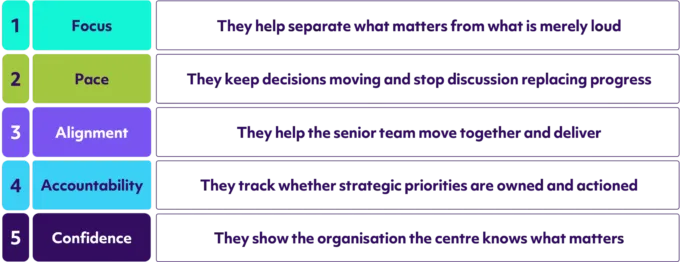
That last point is crucial.
Confidence is not created by optimism. It is created by evidence that the organisation can make choices and act on them.
The real test
The chief of staff role should not become another corporate fashion.
Done badly, it can add confusion. It can become a gatekeeper role, a status role or a vague "special projects" bucket where difficult things go to become less visible.
Done well, it does the opposite.
It reduces noise. It speeds up decisions. It connects strategy with reality. It helps the CEO lead through others, not around them.
For energy leaders, that is especially valuable now.
The next phase of the transition will not be won by ambition alone. It will be won by organisations that can maintain confidence, alignment and trust while making hard choices in public.
That requires strategy but it also requires the machinery of execution.
The chief of staff is not the hero of that story. If they are doing the job well, they may rarely be the most visible person in the roomBut they may be one of the reasons the room works.
And in a sector where the gap between promise and delivery is becoming more exposed, that makes the role essential.